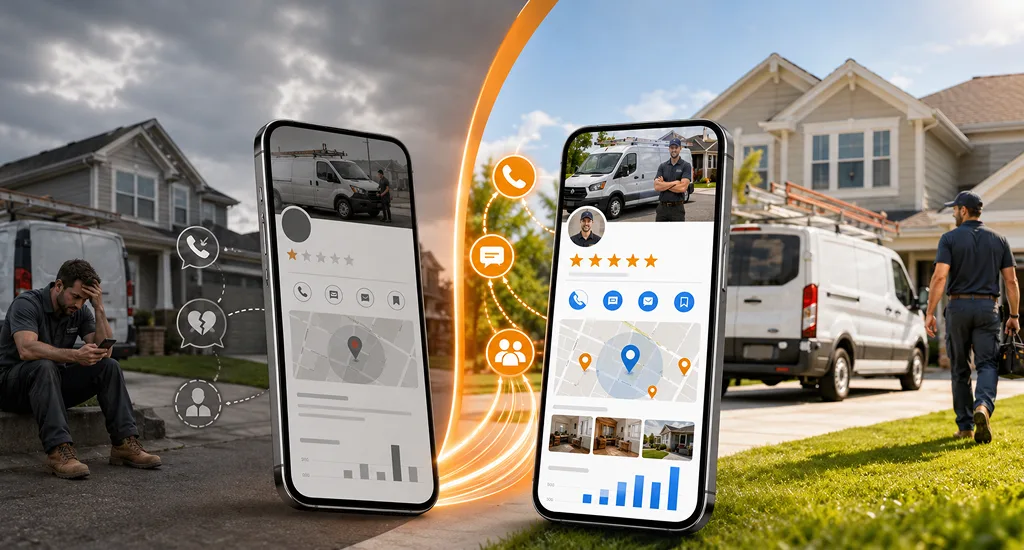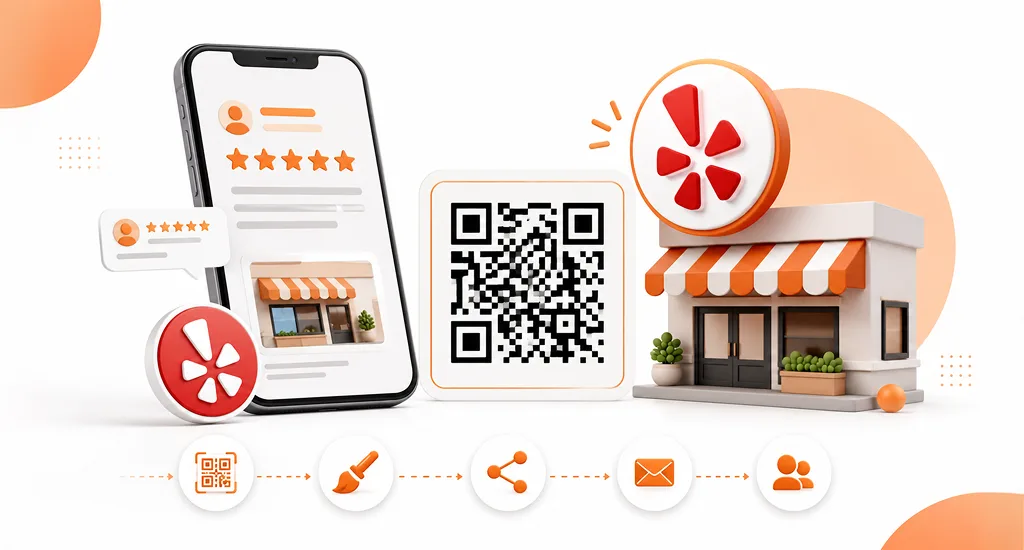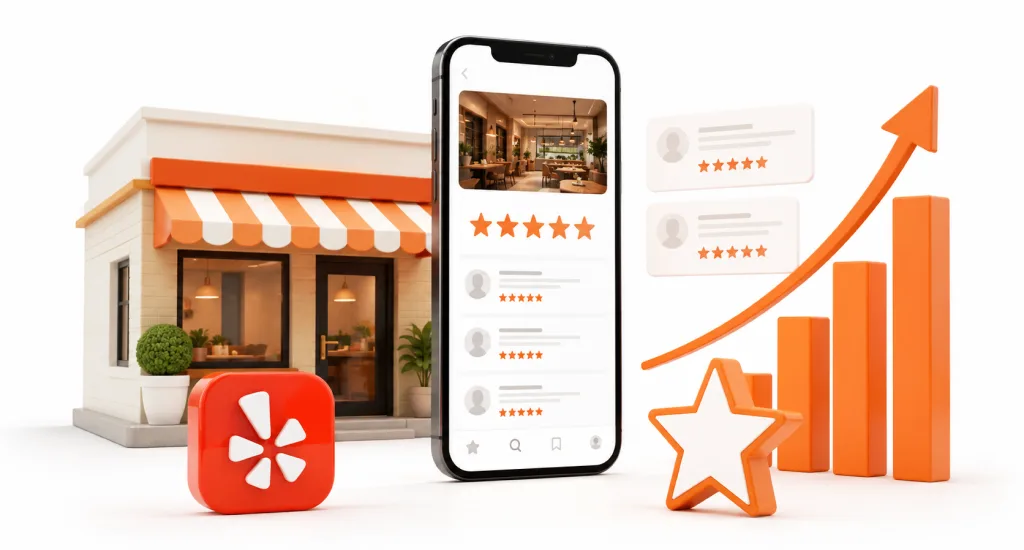
How to improve your Yelp rating comes down to five things working together: a fully optimized Yelp Business Page, a customer experience worth talking about, fast review responses, a real understanding of Yelp’s filters, and visibility you build without ever directly asking for reviews.
None of these works in isolation. A polished profile won’t save a bad experience. And great service means nothing if nobody knows your business is even on Yelp.
The stakes are higher than most owners realize. Harvard Business School researcher Michael Luca found that a one-star increase in Yelp rating leads to a 5 to 9 percent increase in revenue.
At Growth For Local, we’ve spent over four years helping local businesses turn reviews into real growth, and this guide covers exactly how.
Quick Answer: How to Improve Yelp Rating in 6 Steps
- Claim and optimize your Yelp Business Profile
- Deliver a great customer experience every time
- Respond to every review within 24 to 48 hours
- Promote your Yelp presence without asking for reviews
- Understand and work with the Yelp review filter
- Fix negative patterns before they compound
Why Your Yelp Rating Matters More Than You Think
A Yelp rating is a trust signal. It’s the tiny piece of information a stranger relies on to decide, in seconds, whether your business deserves their money.
That split-second decision has real weight behind it. As mentioned above, a one-star review swing can move revenue by 5 to 9 percent according to the Harvard study. Small number, big consequence.
Star rating alone doesn’t tell the full story either.
- A business sitting at 4.8 stars with ten reviews often loses to a competitor at 4.3 stars with two hundred reviews. Volume builds credibility just as much as the average star rating does
- Rating affects more than your Yelp page. It shapes how you appear in local search results on Google, too, not just Yelp itself
- Reviews serve two audiences at once. The person reading them right now, and the algorithm scoring them behind the scenes
Keep both audiences in mind whenever you’re building reviews and citations for local visibility. Write for the human first. The algorithm tends to reward that anyway.
How to Optimize Your Yelp Business Page
Your Yelp Business Page is the free profile Yelp gives every business, and it’s the foundation on which everything else in this guide builds. To improve your Yelp rating, start by claiming that page at biz.yelp.com and filling out every single field.
Seven quick wins, in order:
- Claim your listing at biz.yelp.com
- Add accurate hours, location, phone number, and website URL
- Upload 10 or more real photos (no stock images, ever)
- Pick the most accurate business categories, not just the popular ones
- Fill out “About This Business” with details that actually sound like you
- Add services and specialties (delivery, takeout, appointments)
- Turn on Yelp check-ins so visitors can tag your business
One more thing. Update your profile the moment anything changes. Mismatched info across Yelp, Google, and your own website quietly chips away at your rating, even when nobody’s leaving a bad review over it.
How to Deliver a Customer Experience Worth 5 Stars
Customer experience is simply how someone feels during and after doing business with you, and it’s the one thing you cannot fake your way around on Yelp. The best way to improve your rating is by delivering service so good that people want to talk about it.
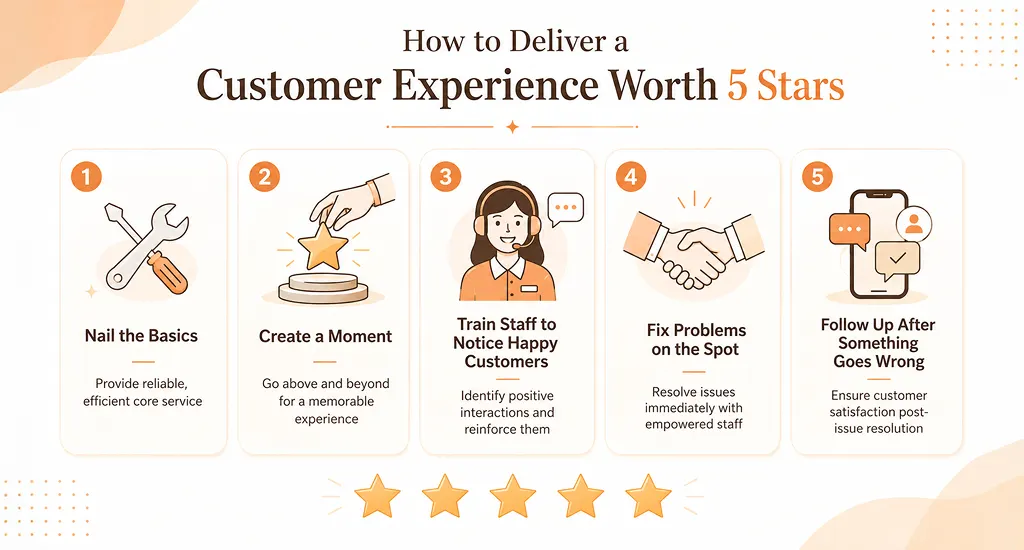
Five things that actually move the needle:
- Nail the basics: Fast service, friendly staff, a clean space, and a product that holds up
- Create a moment: A small personal touch turns an okay visit into a story worth telling
- Train staff to notice happy customers: Those are your natural review moments; catch them
- Fix problems on the spot: A complaint solved in real time rarely turns into a 1-star review later
- Follow up after something goes wrong: A phone call after a bad visit tells someone you actually care
Here’s the honest truth. Reviews are downstream of experience. You can’t optimize, template, or rating-hack your way past bad service, no matter how good your Yelp profile looks.
The Right Way to Get More Yelp Reviews (Without Breaking Yelp’s Rules)
Yelp’s terms of service are blunt on this point: don’t ask customers for reviews. Instead, make your Yelp presence impossible to miss and let happy customers find their own way there.
Six tactics that stay inside the lines:
- Put “Find us on Yelp” stickers on your storefront, window, and reception desk
- Add Yelp badges to your website footer, email signatures, and thank-you pages
- Turn on check-ins so guests can tag your location
- Print a small line on receipts and menus (“Share your visit with us on Yelp”)
- Repost Yelp reviews to social media with attribution; it normalizes the habit
- Never trade discounts, freebies, or cash for reviews
That last one isn’t a suggestion. Yelp’s own guidelines spell out a clear do and don’t list for owners, and soliciting reviews sits firmly on the don’t side. Do claim your page, add photos, and respond to feedback.
Don’t ask anyone (customers, friends, your mailing list) to write one, and don’t offer anything in exchange for it.
According to Yelp, the platform actively targets solicited reviews with its recommendation software, and reviews that look prompted get buried under “not recommended” even when they’re glowing. The businesses with the strongest ratings tend to be the ones that let reviews happen on their own.
How to Respond to Yelp Reviews (Positive and Negative)
A review response is simply your public reply to something a customer already wrote, and responding within 24 to 48 hours signals professionalism that most competitors skip. It can also nudge a reviewer toward an upgrade.
Getting the tone right
Respond to everything, good and bad. Silence on a bad review often reads worse than the review itself. Keep your tone calm and never defensive, even when the review feels unfair.
For a negative review, acknowledge what happened, apologize where it’s warranted, and offer to keep talking somewhere private. For positive reviews, a short thank-you is enough; it keeps loyal customers engaged and shows future readers you’re paying attention.
Never argue in public. Move it to a direct message or a phone call instead.
A template that works
“Hi [Name],
Thank you for taking the time to share this. We’re genuinely sorry your experience did not meet expectations. We’d like the chance to make it right. Please reach out to us at [contact].
Thank you for the feedback.”
When responding to a suspicious 1-star review, stay factual rather than accusatory. Note any details that don’t match your records (a dish you don’t serve, a date you were closed) and invite the reviewer to follow up directly.
Yelp’s own data backs this approach up: responding to negative reviews quickly and courteously increases the odds of a review upgrade, and a thoughtful business owner response often does more for your credibility than the star count itself.
How the Yelp Filter Actually Works
The Yelp filter algorithm is automated software that decides which reviews get shown as “recommended” and which get pushed down to a separate, less visible tab. Reviews from brand-new or barely active accounts often land in that second bucket, even glowing ones.
What the algorithm tends to reward:
- Reviewers with a completed profile (photo, bio, connected accounts)
- A history of writing reviews across more than one business
- Regular check-ins and photo uploads
- Writing that reads like a real person, not a template
- No obvious connection to the business being reviewed
You can’t control the filter directly, and honestly, nobody outside Yelp fully can. But you can nudge happy customers toward becoming active reviewers and trusted users.
Encourage a profile photo, a couple of other reviews, a connected account. Reviews from that kind of profile are far more likely to stay in the recommended, legitimate reviews column.
What to Do About Bad or Fake Yelp Reviews
A fake review is one that doesn’t come from a genuine customer experience, and Yelp treats it very differently from an honest but harsh one. You can’t remove a review just because it’s negative.
You can report one that breaks Yelp’s content guidelines: hate speech, review manipulation, personal attacks, or complaints that have nothing to do with your actual business.
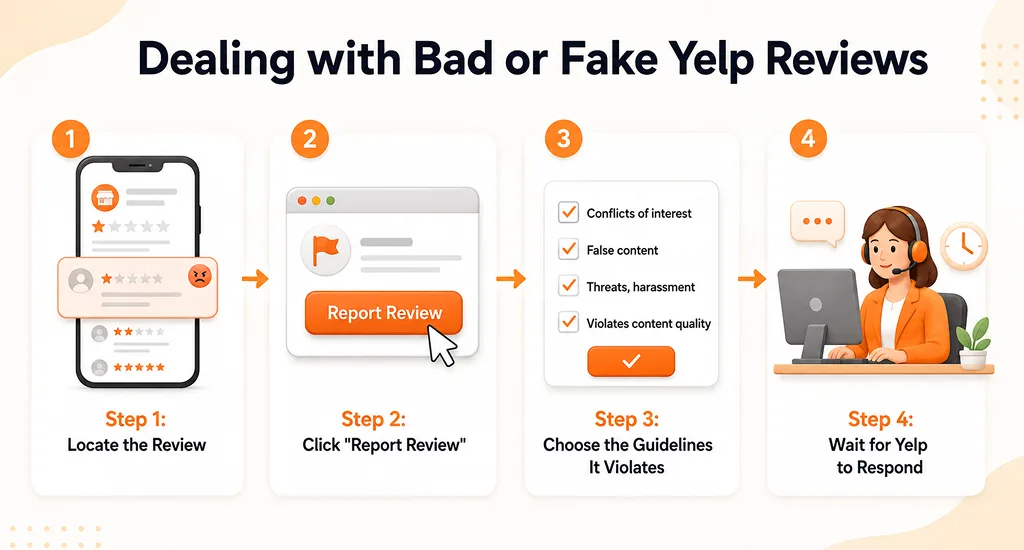
Three steps to flag it:
- Log in to your Yelp Business account and locate the review
- Click “Report Review” and choose the specific guideline it violates
- Wait for Yelp’s team to respond, typically within 5 to 7 business days
That’s roughly how long Yelp takes to remove a review, assuming it actually breaks a rule. If it doesn’t, the review stays up no matter how much it stings.
Worth knowing separately: deleting a review you posted on Yelp yourself works differently and takes about thirty seconds. You just open your own profile, find the review, and remove or edit it. That option only applies to reviews you wrote, not ones written about your business.
If a flagged review stays live, fall back on the response strategy above. A calm, professional reply to an unfair review often wins over more skeptical readers than the review itself loses you.
Final Thought
Improving your Yelp rating is a long game, not a quick fix. It’s built from real customer service, quick review responses, and a Yelp profile that’s actually filled out. There’s no shortcut here, and the Yelp for Business platform is built specifically to punish attempts to game it.
Want more visibility for your local business beyond Yelp? Explore our other guides on local SEO and reputation management at Growth For Local.