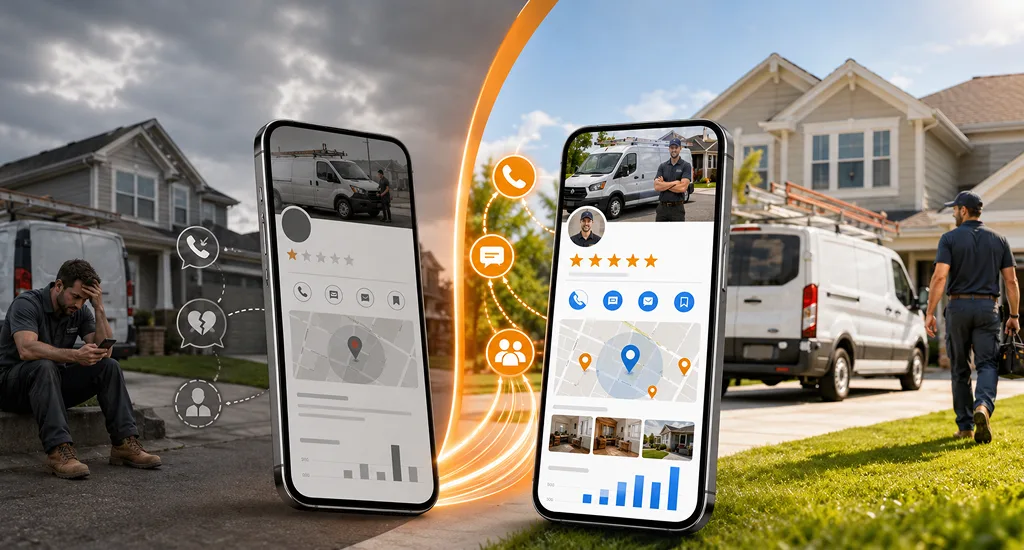
Smart home businesses grow best when local customers can find them quickly. Local SEO for smart home businesses helps people nearby see your services first. Without it, even excellent products can stay hidden from potential clients.
Many companies offer amazing smart home solutions, but most don’t appear in local searches. Local SEO makes your business show up on Google Maps, search results, and directories. It builds trust and makes customers more likely to call or visit. Simple changes online can create big results offline. Thus, they make your business more visible in your area.
This guide shares easy and practical ways to improve your local SEO. If you want more local customers, read this blog with care.
Understanding Local SEO for Smart Home Businesses
Local SEO helps service-based tech providers appear in search results when nearby customers look for their services. For smart home businesses, it means people searching for installers, automation consultants, or integrators can find you quickly.
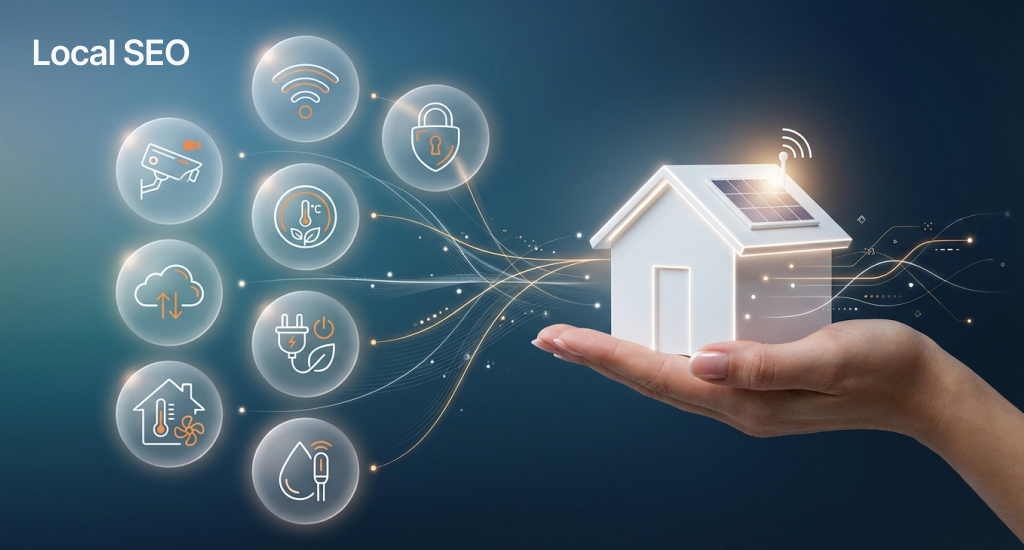
Local SEO is different from general SEO. It focuses on proximity (how close your business is), relevance (how well your services match the search), and prominence (how trustworthy or popular your business seems online). General SEO targets a broad audience, but local SEO targets people who are ready to act nearby.
For smart home installers, automation consultants, and integrators, local SEO is essential. Most homeowners don’t travel far for these services; they want someone local they can trust. Appearing in local searches builds credibility and drives calls or visits.
Data shows that the majority of searches like “smart home installation near me” result in offline conversions. It means the customer often calls, books, or visits after seeing a local listing. Local SEO turns online searches into real business opportunities, making it a must for smart home companies.
Why Local SEO Matters for Smart Home Businesses in 2025
Smart home businesses can no longer rely on random online traffic. Understanding how homeowners search for smart home services near them helps you focus on the channels that actually drive local leads.
Local SEO for smart home business matters more than ever because nearby homeowners want quick and trustworthy solutions. Visibility in local search can make or break your sales.
The Local Intent Shift
Homeowners now look for nearby smart home installers and automation consultants. They prefer businesses that feel close, reachable, and responsive. Appearing in local searches increases the chance of calls, messages, and booked appointments immediately.
Google’s AI-Driven Local Results
AI now powers Google’s Map Pack, Google Business Profile, and voice search. This technology predicts what users want and shows local businesses that match their needs. As a result, it can drive more conversions than generic search results. This is a major advantage for companies using AI-driven SEO techniques.
Voice Search Changes Everything
By 2025 and forward, more local customers speak their queries than type them. Smart home businesses that optimize for voice commands appear in hands-free searches. This approach creates an advantage over competitors who rely only on traditional search.
Mobile-First Local Visibility
Most local searches happen on smartphones. Websites that load fast, display correctly, and provide clear contact info gain priority. Mobile-focused web design ensures potential customers find your business instantly on their smartphone.
Step-by-Step Playbook for Smart Home Companies
A practical guide can help small smart home businesses dominate local markets. From profile setup to reviews and maps, every step builds real credibility. Consistent efforts improve visibility and attract more local clients.
Future-Proof Your Business
AI, voice search, and mobile trends will continue shaping local SEO for service area businesses. Smart home businesses that adapt early will stay ahead, capture local demand, and turn online searches into real sales. Ignoring these shifts is one of the top reasons home automation startups fail to scale locally, even with great tech.
Localized website architecture for Local Smart Home SEO
A well-organized website helps Google and visitors understand where your business operates and the services you provide. A proper local structure improves visibility, builds trust, and increases the chances that local customers will reach out. Without that clarity, it becomes another example of why your smart home business struggles to generate local leads even when demand exists.
Homepage Signals
Your homepage should clearly show the city or region you serve in both the page title and meta description. Avoid cramming keywords; instead, try to make it natural and informative. Visitors should instantly know your business is local.
Service Area Pages
Create a separate page for every city or neighborhood you actively serve. Try to add unique content for each area, include local photos, embed a map, and highlight a small case study. You should use schema markup to define the area served for search engines.
Project Pages and Case Studies
Showcase past projects with before-and-after photos. Try to explain the problem, the solution you provided, and the results. You should also include estimated installation time and price ranges to help visitors understand the scope and set of expectations.
Location Snippets & CTAs
Make it easy for local visitors to act. You should include click-to-call buttons, request-a-quote forms, and show your next available appointment slot. These features reduce friction and turn visitors into real leads quickly.
Internal Linking
You should connect your homepage to service pages, case studies, and contact pages in a logical flow. Adding the FAQ schema on relevant pages answers common questions. Also, it improves your website’s local SEO strength.
Maximize Local Visibility with a Perfect Google Business Profile
A strong Google Business Profile (GBP) is the easiest way for local homeowners to find your smart home business. Optimizing your profile improves search visibility, encourages calls, and brings more project inquiries.
Set Up and Verify
Claiming your Google Business Profile is the first step. Proper verification confirms your business is real, which lets you appear on Google Maps and local search results. Without verification, your business may remain invisible to local customers.
You should choose accurate categories for your services. Categories like Smart Home Installation, Home Automation Consultant, or Home Security System Service ensure Google understands what you do. Also, correct categories increase the chances of matching relevant local searches.
- Verification can be done via mail or phone.
- Select only categories that reflect your main services to avoid confusion.
- Accurate categories help Google prioritize your profile in local search results.
Optimize Every Field
Every field in your GBP matters. You should add a precise Name, Address, and Phone number (NAP) along with operating hours. A clear and keyword-rich business description like “smart home installation in [City]” helps Google connect you with local searches. High-quality photos that show your team, vehicles, completed projects, or before-and-after results gain you trust, visibility, and local branding.
Upload high-quality photos that show your team, vehicles, completed projects, or before-and-after results. Visual content builds trust and helps homeowners feel confident in your services.
- Embed Google Maps on your website’s contact page.
- Include geo-tagged images for better local ranking.
- Ensure all information matches across online listings for consistency.
Maintain and Engage
Active profiles perform better in local searches. You should post weekly updates showcasing new products, offers, or completed projects. Engaging consistently on social platforms keeps your profile fresh and visible to searchers.
Try to engage with visitors through the Q&A section. You should enable direct messaging and reply promptly. Fast responses improve customer trust and encourage potential leads to take action.
- Answer common homeowner questions in Q&A.
- Highlight seasonal offers or new services in posts.
- Track engagement to see which updates get the most attention.
Review Strategy
Reviews influence local buying decisions heavily. You can add a system to collect reviews after project completion through SMS or email follow-ups. Positive reviews boost credibility and search ranking.
You should respond to all reviews, good or bad, within 24 hours. This action shows professionalism and dedication to customer satisfaction. You should display your top reviews on both your website and GBP to attract more local clients.
- Feature testimonials from recent projects.
- Encourage detailed reviews mentioning services and locations.
- Monitor trends in feedback to improve services.
Track and Update
Monitoring your GBP is fundamental. You should use insights to understand which searches bring the most visitors. Regularly update services, hours, and photos to maintain relevance.
If your local business stays current and gets found online, it will ensure that you remain competitive in local search results. Additionally, it will attract more nearby customers over time. Regular updates show both Google and homeowners that your business is active and reliable.
Strengthen Your Local Authority with Consistent Citations
Consistent online information builds trust for both Google and potential customers. Citations, mentions of your business name, address, and phone number (NAP) on other websites. Also, it signals overall reliability. Local businesses with accurate citations rank higher in search results.
Maintaining authority online is more than listing your business everywhere. Regular audits and careful submission to trusted directories ensure you stay visible and credible in your local area.
Check and Correct All NAP Details
Audit every online mention of your business using tools like BrightLocal or Moz Local. You should identify errors, outdated addresses, or old phone numbers and correct them immediately. Consistency improves Google’s trust and makes it easier for customers to reach you.
- You should make sure the business name, address, and phone number are exactly the same on all listings.
- Correct typos, old addresses, and outdated numbers.
- Keep a record of changes to maintain long-term consistency.
List Your Business on Trusted Directories
You should submit your business to major and niche directories where local customers search. Popular options include Yelp, BBB, Apple Maps, Bing Places, and HomeAdvisor. Listings on these sites increase visibility and credibility.
- Focus on directories relevant to smart home services.
- Avoid low-quality or spammy sites; they can hurt your rankings.
- You should complete each profile fully with accurate NAP, photos, and service descriptions.
Prioritize Quality Over Quantity
Not all directories carry the same weight. Google favors authoritative, local, and industry-specific directories over hundreds of random listings. Try to concentrate on platforms that enhance your reputation and local reach.
- You should choose directories with strong domain authority.
- Include local business networks and smart home associations.
- Ensure every listing contains consistent NAP, website link, and business category.
Keep All Information Updated
Once listings are created, monitor them regularly. You should update hours, services, or contact information promptly. Consistency shows Google and customers that your business is active, reliable, and professional.
- Schedule quarterly checks of your key listings.
- Try to update photos, promotions, and service offerings as needed.
- You should remove duplicate or inactive listings to avoid confusion.
Optimize Your Website for Local Search Performance
A website is the foundation of your local SEO strategy. Optimizing it for local search helps Google understand your business location, services, and authority. It increases your chances of showing up in searches from homeowners nearby.
Local optimization also improves user experience. Visitors can easily find your contact info, browse services, and take action. Also, it will turn online visits into real leads for your smart home business.
On-Page SEO Essentials
Your website should clearly display your business name, address, and phone number on the footer and contact page. It helps search engines, and visitors know exactly where you operate. Accurate contact info and seo for small local businesses also builds trust with local customers.
Title tags and meta descriptions should include local keywords naturally, for example, “Smart Home Installation in [City].” You should add LocalBusiness schema markup to service and contact pages so Google can read your business details easily.
- Use HTTPS for security.
- Make the website mobile-friendly for all devices.
- Try to ensure fast loading times to keep visitors engaged.
Location and Service Pages
You should create separate city-specific pages for each area you serve, like “Smart Home Installation in Austin.” It tells Google and visitors that you are active in those locations.
Add local testimonials, project photos, and embedded Google Maps to make each page unique and trustworthy. You can write unique meta titles and descriptions for each page to avoid duplicate content penalties.
- Highlight local client success stories.
- Include maps showing service coverage.
- You should showcase before-and-after project photos.
Technical and UX Optimization
Website speed, responsiveness, and stability are essential for Core Web Vitals. A clean internal link structure helps visitors navigate from the homepage to services, projects, and contact pages easily.
Clickable calls-to-action (CTAs) and local contact forms improve lead generation. Optimizing technical and UX elements ensures visitors stay longer and convert into real customers.
- Prioritize fast-loading images and scripts.
- You should add clear navigation menus for the service hierarchy.
- Test contact forms to ensure submissions work flawlessly.
Create Localized Content That Attracts Customers for Home Businesses
Content is a powerful tool for smart home businesses to attract nearby homeowners. Localized content tells Google and visitors exactly where you operate. Also, this helpful information builds trust and authority.
Providing value through content also improves engagement. When homeowners find guides, case studies, or tips specific to their area, they are more likely to call, request a quote, or explore your services.
Write City-Specific Blog Posts and Guides
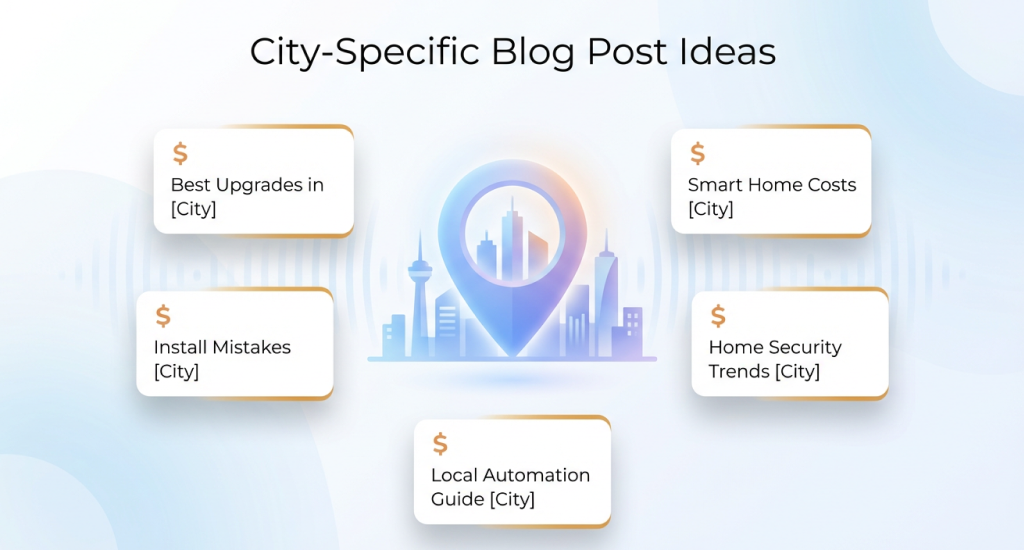
You should create blogs or guides that address local homeowner needs. Examples include “Top 5 Smart Home Upgrades for [City] Homeowners” or “How We Installed Whole-Home Automation in a [City] Suburb.” These posts show your expertise and make your business visible in local searches.
You can customize content to the region’s climate, culture, or common problems. For example, “Best Smart Lighting Systems for Cold [Region] Winters” targets readers looking for solutions relevant to their environment.
- You should highlight real projects in the city.
- Include images or videos of completed installations.
- Try to use local keywords naturally without overstuffing.
Add FAQs for Voice and AI Searches
Voice searches are growing rapidly. People often ask questions like, “How much does a smart home setup cost in [City]?” Adding FAQs answers these queries and helps your content appear in voice search results.
Well-structured FAQs also improve your chances of being featured in Google’s snippet boxes. It will increase your visibility and credibility.
- Include common homeowner questions in your area.
- Try to use natural, conversational language for AI optimization.
- Update FAQs regularly based on customer inquiries.
Showcase Case Studies and Customer Stories
Sharing real-life success stories builds trust. Case studies should highlight the problem, solution, and measurable results of your projects. It reassures potential customers about your reliability and expertise.
Local stories ring more with readers. Including photos, before-and-after shots, and testimonials makes the content engaging. Also, it encourages homeowners to take action.
- Highlight measurable results like energy savings or installation time.
- You can add quotes from satisfied clients.
- Link case studies to relevant service pages for easy navigation.
Build Local Backlinks and Partnerships to Boost Local Authority
Backlinks from trusted local sources show Google that your smart home business is reliable. They also bring nearby homeowners straight to your website, increasing calls and inquiries. Partnerships and collaborations amplify your visibility in the community.
Get Links from Local Sources
You can reach out to your Chamber of Commerce, local newspapers, or professionals like electricians and realtors. Even a simple mention on their website can boost your credibility. Try to focus on quality over quantity; one strong local link is better than many low-value ones.
- Target sites your potential customers already trust.
- You should make sure the link points to a relevant page, like your services or location.
Collaborate with Other Local Businesses
Team up with related service providers, like HVAC or security companies. You can co-host events, share blog posts, or promote each other on social media. Collaborations help both businesses reach new audiences naturally.
Participate in Community Events
Sponsoring or attending local events like workshops, fairs, or trade shows does more than improve visibility. Event listings often link back to your website, and homeowners get to meet you in person. It really builds trust instantly.
Share Your Expertise
You should contribute tips, interviews, or case studies to local blogs, podcasts, or magazines. It positions you as the smart home expert in your area. You don’t need dozens of links; just a few high-quality mentions go a long way.
By mixing backlinks, partnerships, and local engagement, your business becomes more visible, trustworthy, and discoverable. Small and consistent efforts can turn online searches into real-world customers.
Utilize AI, Voice Search, and Emerging 2025 Trends to Improve Local SEO for Smart Home Businesses
Voice search and AI are transforming how homeowners find smart home services. People no longer type exact queries; they speak naturally, asking, “Hey Google, who installs smart home systems near me?” Optimizing for conversational search helps your business appear in these results.
AI tools make local SEO for service area businesses easier and more precise. They help organize keywords, suggest content ideas, and even create review response templates. It saves time while keeping your online presence consistent and professional.
Structured data further helps Google understand your services. Also, they boost your chances of appearing in AI-powered search summaries.
Automation also simplifies monitoring. You can track reviews, report on local performance, and identify opportunities without spending hours manually. It ensures your smart home business stays visible and responsive in an increasingly AI-driven search landscape.
- Optimize for natural and conversational queries used in voice search.
- You should use AI tools for keyword clustering, content ideas, and review responses.
- Try to add structured data like the LocalBusiness schema for better AI recognition.
- Automate review tracking and local performance reports to save time.
- Keep your website and listings updated according to emerging search trends.
Build Trust with Your Online Reputation and Local Social Presence
A strong online reputation helps homeowners trust your smart home business before they even call. Consistent brand voice across your website, social media, and listings makes your business look professional and reliable.

You should engage actively with your audience. Respond to comments, messages, and local inquiries promptly. Quick responses show that your business cares and encourages potential customers to take action.
Highlighting positive reviews and customer success stories on social media also reinforces trust and credibility.
Combining local SEO with paid Local Services Ads gives a hybrid approach. You can appear in organic search, Maps, and sponsored listings at the same time. This approach will surely improve your visibility and leads.
- Maintain the same brand tone and style across all platforms.
- You should share reviews, before-and-after project photos, and testimonials.
- Respond quickly to social mentions, questions, or complaints.
- Try to use a mix of organic SEO and paid local ads to maximize reach.
Track, Measure, and Continuously Improve Your Local SEO
Monitoring your smart home business’s online performance ensures your efforts actually work. Tools like Google Analytics, Search Console, and Google Business Profile Insights show how many people visit your site, view your profile, or request directions. If you track these metrics, they will help you spot what’s effective and what really needs improvement.
Measuring results goes beyond just visits. You should keep an eye on local keyword rankings, click-through rates in the map pack, calls, and direction requests. These metrics reveal whether homeowners are finding and engaging with your business online.
Regular competitor audits provide valuable insights. Try to look at their service categories, review strategies, and content themes to identify opportunities you can utilize. Also, look for the top marketing mistakes of your top local service business, like ignoring negative reviews or weak local pages.
- You should refresh Google Business Profile posts each quarter.
- Update photos of your team, projects, or completed installations.
- Try to refine schema markup to improve search visibility.
- Compare your performance against competitors to stay ahead.
Continuous tracking, measuring, and adapting ensure your smart home business stays visible and competitive in the local market. Small but consistent updates over time result in bigger outputs in both search rankings and real-world customer engagement.
Local SEO Checklist for Smart Home Businesses (2025 Edition)
Local SEO helps smart home businesses get found online by homeowners nearby. From Google Business Profile optimization to website improvements, backlinks, and voice search readiness, following this checklist ensures your business stays visible, trusted, and competitive. You should use it as a step-by-step guide to improve your local search performance and attract more clients in 2025. Local SEO Checklist for Smart Home
End Note
Local SEO helps a smart home business turn online interest into real installations. Strong visibility in the map pack, trusted reviews, clear local pages, and helpful content make homeowners feel confident when they choose you. These steps shape how people see your brand and how easily they can reach you.
Local SEO grows over time, not in one setup. Small updates, fresh content, new reviews, and regular tracking keep you ahead of local competitors. So, start improving your local presence today and move your smart home business toward stronger growth and steady trust.