
Common marketing mistakes small businesses make are failing to research target audiences, lacking marketing strategy documentation, ignoring Google Business Profile optimization, and over-relying on word-of-mouth referrals.
- No audience research (wasting 40% of ad spend)
- Ignoring online reviews (losing 86% of customers who read negative reviews)
- Weak Google Business Profile (missing 70% of local search visibility)
- Over-reliance on referrals (limiting growth to 5-10% vs 25-40% with full potential)
To fix these mistakes, research your ideal customer’s age, income, and location before spending $1 on ads. Respond to every review within 24 hours using a template. Complete all 12 sections of your Google Business Profile, including posts, photos, and Q&A. Allocate 15-20% of revenue to paid ads, SEO, and email marketing alongside referrals. The good news is that each mistake has a simple fix. This blog will show you how to avoid them. Keep reading.
Why Local Marketing Mistakes Cost More Than You Think
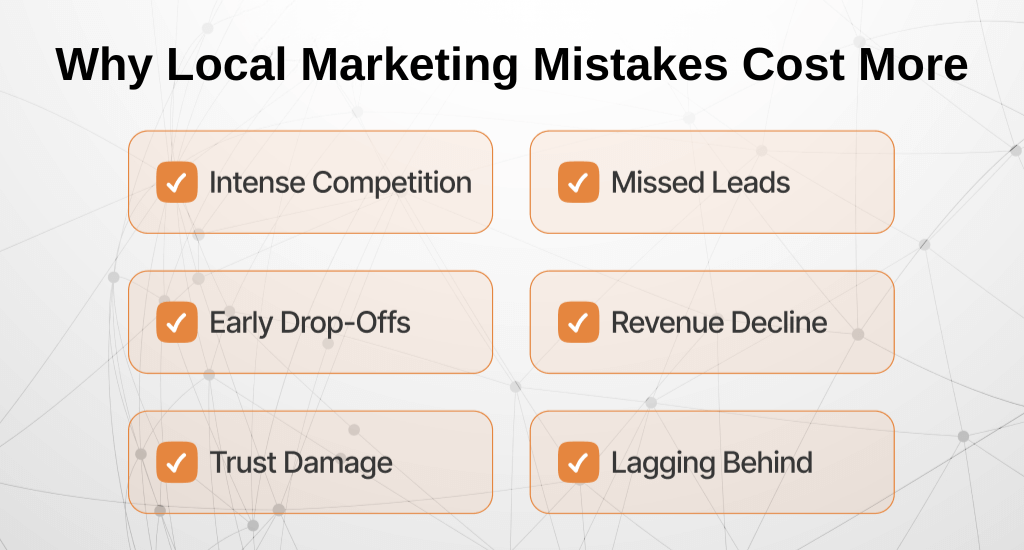
Local business marketing mistakes don’t just hurt your image; they hit your bottom line hard. In a crowded local market, small business owners who ignore strategy lose leads, lose revenue, and fall behind fast.
-
Fierce Local Competition
Your service area likely has many rivals. If your marketing is weak, customers will choose competitors who look more visible. In local business marketing, being noticeable matters more than you think.
-
Lost Leads That Never Call
One of our studies shows that small firms lose 73% of leads because of poor response systems. If prospects never get a reply, they switch to someone else for sure. That’s a lost opportunity, pure and simple.
-
Leads Drop Off Before You Engage
At Growth for Local, we’ve seen how small process gaps can cost big opportunities. Our studies show a major follow-up gap between marketing and sales. 73% of leads are never contacted, according to Channel Futures, and 25% of online leads are completely lost. That means many potential customers never hear from your team at all.
-
Drop in Revenue Over Time
When too many leads vanish, your revenue shrinks month by month. Even small leaks in conversion add up. Small business owners begin to face cash shortfalls or struggle to pay expenses.
-
Reputation and Trust Erode
If reviews are ignored or your Google Business Profile is weak, your reputation suffers. In local business marketing, trust is key. Poor feedback or no presence makes customers doubt you. A strong Google Business Profile and local branding connect your business with the consumers.
-
Falling Behind Others
Once you lag in marketing, your rivals will pull ahead. When local customers search for your service, they see better profiles, stronger presence, and better reviews, and you lose. The cost is more than dollars; it is your future.
Strategy & Audience Mistakes That Hold Businesses Back
A big reason why many small business campaigns fail is weak planning and poor audience focus. Without a clear digital marketing strategy, money goes out, but results don’t come in. Let’s break down the common mistakes and fixes below.
1. Failing to Define a Clear Digital Marketing Strategy
Many owners try random tactics, like post on Facebook today, run an ad tomorrow, and send an email next week. This scatter approach wastes effort. A clear digital marketing strategy works like a roadmap. You need to:
- Set clear goals (calls, leads, sales)
- Make a complete marketing checklist for your local business.
- Plan a marketing calendar
- Map out the customer journey from first click to purchase

Without these steps, you will never know if actions are building toward real growth.
2. Poor Audience Research & Targeting
Trying to sell to everyone is a costly mistake. Our research shows, 37% of ad spend is wasted due to poor targeting. Instead, focus on your real audience. Find out where your real consumers are buying from. Use Google Ads and Meta Ads targeting tools to reach buyers who actually convert.
The fix is simple:
- Use Google Analytics to see who visits your site
- Run small surveys to learn customer needs
- Check Meta Audience Insights to refine interests3. Ignoring the Customer Journey
A customer rarely buys at first glance. They go through the steps:
- See your ad
- Visit your website
- Check reviews
- Then decide
If you ignore this journey, your messages don’t match their stage. You should draw a simple path and match your content at each step.
4. No Tracking and Measurement
Many owners run ads or social posts without tracking results. Google reports that 56% of ad impressions are never seen. If you don’t measure, you won’t know which half of your budget is wasted. You should use Google Analytics, Meta Pixel, or call tracking to see what truly works.
Online Presence Mistakes That Hurt Your Local Reach
If your business profile, listings, and SEO are poor, many local people will never find you. Fixing these online presence mistakes is urgent; your rivals may already be winning your customers.
-
Ignoring or Mismanaging Google Business Profile (GBP)
Many businesses set up a GBP once and then forget it. They leave hours blank, use wrong phone numbers, or never respond to reviews. But a well-optimized Google Business Profile helps people to call, visit your site, or ask for directions. For example, a profile with photos is more likely to look trustworthy.
Fix: You can fill all fields (hours, services), upload clear images, and answer reviews, good and bad. Keep the info fresh.
-
Inconsistent NAP Citations Across Directories
Your NAP means Name, Address, Phone. When your business name is “ABC Plumbing” in one place and “ABC Plumb Co.” elsewhere, or phone formats differ, search engines get confused. Inconsistent data kills user trust & local SEO efforts.
Fix: Use tools like BrightLocal or Yext to audit and fix these listings. You can pick one “master” format and apply it everywhere.
-
Weak Local SEO Efforts
Many skip optimizing for “near me” searches or location + keywords. They treat content as if they’re serving all cities. That can rarely win local leads.
Fix: You should use geo-modifiers (like “Brooklyn plumber near me”), build local backlinks (from nearby businesses or media), and add schema markup so Google knows your location.
-
Broken or Missing Website NAP & Contact Page
Some sites forget to place their address or phone number clearly on every page. Or sometimes they omit maps or contact forms.
Fix: Try to show your NAP on the header or footer of all pages. Add a clear contact page with a map, directions, and a click-to-call.
-
Ignoring Mobile and Speed Issues
Your site may be slow or not mobile-friendly. Many local searches happen on phones. If your pages load slowly or look bad on small screens, people will leave fast.
Fix: You can use tools like Google’s PageSpeed Insights to test your site. Make images small, use good hosting, and ensure the layout adapts to mobile.
Customer Engagement Mistakes That Cost You Leads
When a business ignores customer relationships, growth slows down. Referrals and repeat clients keep many small firms alive. Without consistent engagement, that flow dries up. Strong engagement can create steady sales.
1. Relying Too Much on Referrals Alone
Referrals are valuable. A happy client recommending you to a friend is powerful and free. But referrals are not scalable, and you cannot predict when they will come. If you wait only for word-of-mouth, you risk dry months with no new clients.
Fix: You should balance referrals with digital channels like Facebook ads, email newsletters, local SEO, and seasonal marketing. It gives you a pipeline of leads even when referrals slow down.
2. Neglecting Paid Social Media Advertising
Organic reach on platforms like Facebook and Instagram has dropped sharply. A study shows organic reach is now around 1.37% on Facebook. If you post without ads, only a small part of your audience sees it.
Fix: You can start with small ad budgets. Test different audiences, then use retargeting so ads appear again to people who visited your website. It can build brand recall at a low cost.
3. Poor Customer Engagement & Follow-Up
Many small business owners fail to follow up after service. Ignoring reviews or skipping thank-you emails makes customers feel forgotten. Research shows 80% of consumers say they would switch brands after poor customer service.
Fix: Use CRM tools to track leads and automate follow-up emails. You should thank customers, ask for feedback, and respond to every review.
4. Lack of Loyalty & Referral Incentives
Even satisfied customers may not refer you unless they have a reason. If you never reward loyalty, they may forget you in no time.
Fix: You should create simple loyalty perks, like discounts, free add-ons, or gift cards for each referral. This small effort builds lasting relationships.
5. Weak Content & Communication Strategy
Some businesses post randomly or send dull newsletters. Without regular and helpful communication, customers lose interest.
Fix: Always share content that solves real problems, schedule posts consistently, and invite interaction. You can use questions or polls to spark conversations, not just promotions.
Execution & Measurement Mistakes That Hold Businesses Back
Good marketing isn’t just about running campaigns; it’s about how you execute and measure them. Many small business owners work hard but miss major steps. Check out the following common marketing mistakes of small businesses.
a. Failing to Track ROI & Marketing Metrics
One of the most common errors is running ads and then saying, “It didn’t work,” without checking the numbers. If you don’t track calls, form fills, or conversions, you won’t know which channel actually brings sales.
Fix: You should use tools like Google Analytics 4 to track website actions, call tracking for phone inquiries, and dashboards that show leads from each campaign. This way, you’ll know where your money works best.
b. Sticking with Outdated Marketing Tactics
Some businesses still rely heavily on print ads, flyers, or cold calling while ignoring how customer behavior has changed. In 2025, people will spend more time on TikTok, Instagram Reels, and AI-powered platforms than reading local print.
Fix: Try to stay updated with trends. Experiment with short-form video, automation tools, and AI-driven personalization. These modern tactics are more engaging and cost-efficient.
c. Ignoring Customer Feedback in Execution
Even if you run ads, poor service or unclear communication will make campaigns flop. Customers often leave reviews or comments that reveal what went wrong, but many businesses ignore this feedback.
Fix: Actively monitor reviews, social mentions, and post-purchase surveys. You can use this input to adjust messaging, improve service, and refine marketing campaigns.
d. Not Testing & Optimizing Campaigns
Another mistake is running one version of an ad or email and assuming it works. In reality, small tweaks, like a headline change or a different image, can double results.
Fix: Run A/B tests on ads, emails, or landing pages. You should track performance over time and keep the winners. It prevents wasted spending and steadily improves ROI.
2025-Specific Local Marketing Challenges
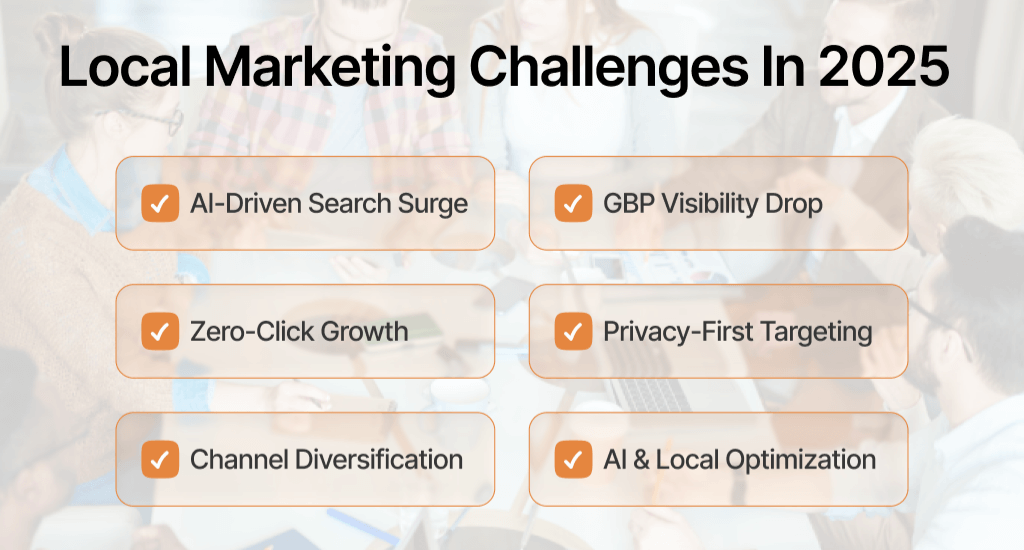
Local marketing isn’t what it used to be. In 2025, small businesses face challenges from AI-driven search, shrinking visibility on Google Business Profile, and stricter privacy rules. To stay competitive, owners must adapt quickly and rethink their strategies.
A. Rise of AI-Powered Search
Tools like Google Gemini and Perplexity AI are shaping how people search. Instead of showing a long list of links, they give one direct answer in a conversational style. If your business details, services, and reviews are not optimized for AI tools, you risk being invisible. No matter if you rank on the traditional Google search.
B. Decline in Google Business Profile Visibility
Google is testing new layouts that push Business Profiles lower on the results page. It matters because many local customers rely on GBP to call, check hours, or read reviews. Without proper optimization, fresh photos, accurate NAP (Name, Address, Phone), and responses to reviews, your profile may no longer stand out.
C. Growth of Zero-Click Searches
According to Exposure Ninja, nearly 58% of searches end without a click. People get answers directly from Google or AI summaries and never visit a website. If your content doesn’t target snippets, FAQs, and structured data, you lose traffic that could have turned into calls or visits.
D. Stricter Privacy-First Ad Targeting
With more users protecting their data, ad targeting is harder than before. In fact, 63% of internet users care deeply about online privacy. It makes hyper-detailed targeting less reliable. To adapt, small businesses must rely more on first-party data like email lists and reviews, and less on third-party cookies.
E. Importance of Diversifying Channels
Depending on one platform, whether it’s Google, Instagram, or referrals, is risky. An algorithm change can wipe out leads overnight. That’s why combining social media, email, local SEO, and even paid ads creates a steady and safer flow of leads.
F. Optimizing for AI & Local Content
AI tools reward content that is clear, structured, and trustworthy. Publishing local guides, FAQ pages, and updated reviews increases the chance of your business being mentioned in AI-driven results. It can keep your site visible even in zero-click searches.
Recovery Strategies for Local Service Businesses
Even a simple small business marketing mistake in local marketing can pile up, affecting leads, reputation, and revenue. The good news is that businesses can recover quickly with focused strategies. Audit your online presence, fix errors, and improve engagement to restore visibility and attract steady customers again.
-
-
-
Run a Full Local SEO Audit
-
-
You can start by checking how your business appears online. Look at your website, Google Business Profile, directory listings, and local citations. Try to identify broken links, missing information, slow pages, or outdated content. A full audit highlights weak areas so you know exactly what needs fixing.
-
-
-
Fix Google Business Profile & Directory Listings
-
-
Your GBP and other local listings must be accurate and consistent. You should check hours, phone number, address, and services. Add high-quality images and respond to all reviews. You can use tools like BrightLocal or Yext to update multiple directories at once. They can save time and avoid errors.
-
-
-
Reset Ad Targeting with Better Audience Research
-
-
If past ads performed poorly, it might be because of targeting the wrong audience. You should use tools like Google Analytics, Meta Audience Insights, or surveys to understand your ideal customer. Adjust your ads based on age, location, and interests to reach people who are more likely to convert.
-
-
-
Collect and Showcase Customer Reviews
-
-
Reviews build trust quickly. Reach out to past clients for feedback, then highlight the best ones on your website and social media. You should respond politely to negative reviews, showing that you care. Positive reviews improve visibility on Google and make new customers more confident.
-
-
-
Update Content & Messaging
-
-
Your website and social posts should clearly explain your services and local advantages. Try to add FAQs, local guides, or service tips. Consistent content improves SEO and helps potential clients understand why they should choose your business.
-
-
-
Monitor Results and Adjust
-
-
Finally, you should track the improvements. Use Google Analytics, call tracking, or CRM tools to see which changes bring more leads. You should adjust campaigns and content as needed. Small but regular tweaks can maintain growth and prevent past mistakes from repeating.
Tools & Resources to Avoid Marketing Mistakes
Running marketing campaigns without the right tools is like driving blindfolded. Small business owners can save time and get better results by using simple tools. From local SEO to analytics, social media, and customer engagement, the right resources make marketing more effective.
1. Local SEO Tools
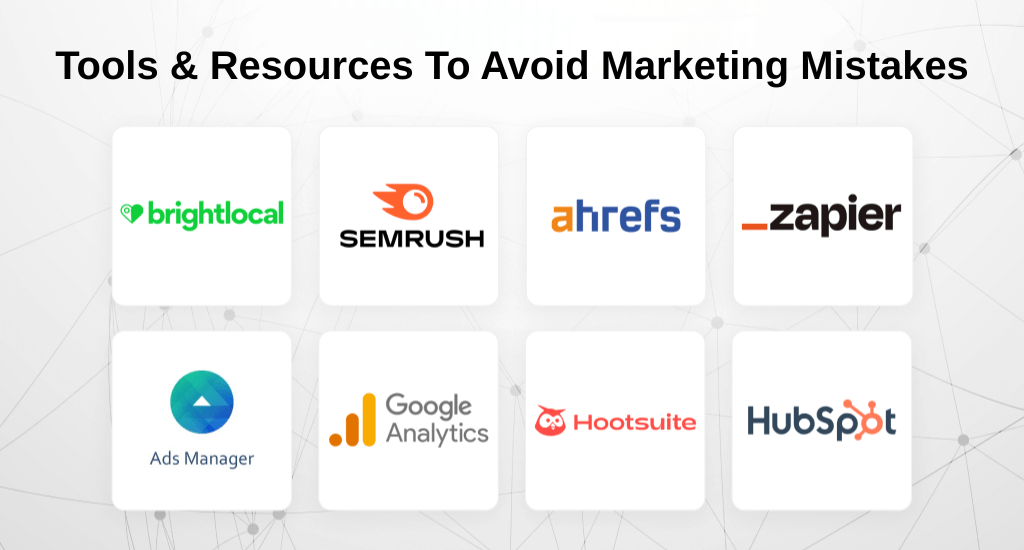
Tools like BrightLocal and Whitespark help track your Google Business Profile, directory listings, and local citations. They show inconsistent NAP (Name, Address, Phone) info and missing reviews. These tools can make it simple to fix errors and improve your visibility in local searches.
2. Analytics & Tracking Tools
You need numbers to see what works. Google Analytics 4 (GA4) shows website visits, conversions, and user behavior. CallRail or other call-tracking tools show which ads or listings actually bring phone calls. With these insights, small businesses can stop wasting money and focus on what brings leads.
3. Social Media Tools
Organic social reach is limited, and managing multiple platforms can be overwhelming. Tools like Meta Ads Manager, Hootsuite, and Buffer let you schedule posts, run paid campaigns, and track performance. These platforms make it easier to stay consistent, reach the right audience, and save hours of manual work.
4. CRM & Customer Engagement Tools
Keeping in touch with clients builds trust and repeat business. HubSpot, Zoho, and Podium help manage leads. Also, they automate follow-ups, collect reviews, and track customer interactions. A CRM ensures no client is forgotten and your marketing efforts stay coordinated.
5. Competitor & Market Research Tools
Tools like SEMrush or Ahrefs show what competitors are doing, which keywords are performing, and where opportunities lie. Small business owners can use this data to make smarter decisions about SEO, content, and advertising.
6. Automation & Productivity Tools
Beyond core marketing, automation tools help manage emails, social posts, and reporting. Platforms like Zapier connect different apps to save time. These tools reduce errors, ensure consistency, and free up time to focus on customer service.
Final Thought
Avoiding the top marketing mistakes small businesses make can save time, money, and reputation. Simple steps, like conducting audience research, managing reviews, and keeping your Google Business Profile up to date, can make a significant difference.
Success does not always need a big budget; it needs smart choices and steady action. Now that you know the common errors, it’s time to fix them. Start small, stay consistent, and watch your local service business grow stronger every day.