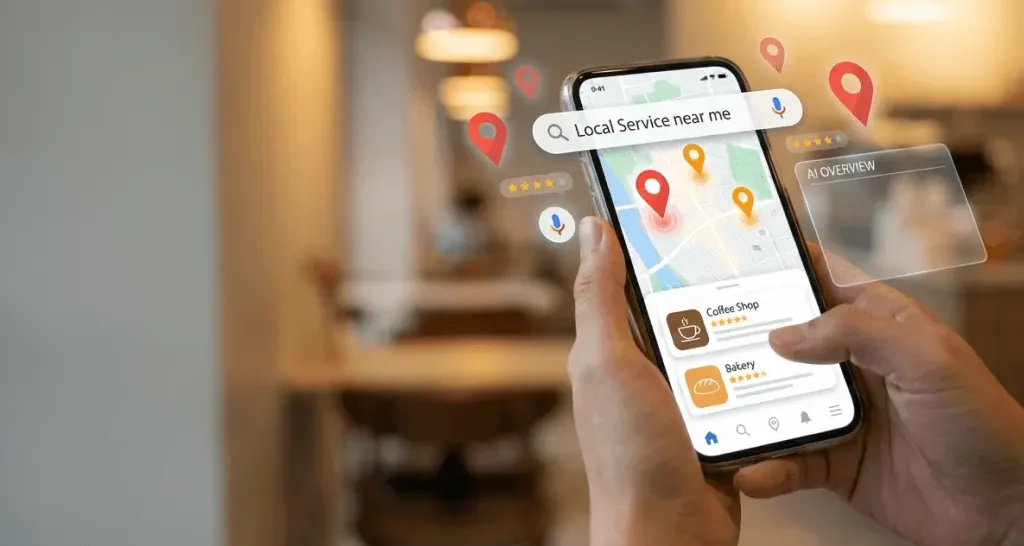
In 2025, people are searching for local services mostly online. They use their phones, voice assistants, and AI tools to find what they need fast. Most local searches happen on mobile, and 84% of users search from their phones. Many also use voice assistants like Alexa or Google Assistant, and 72% of them search by voice to find nearby services.
AI now plays a big role. About 60% of users click AI overviews, and many never visit a website because Google shows answers directly. Reviews and reputation still matter most. Three out of four people read at least four reviews before choosing a business.
Younger people often search on TikTok or YouTube, while older users still prefer Google. Businesses with a full Google Business Profile are 50% more likely to get customers.
Numbers show what habits people follow today and what may grow tomorrow. This blog explains how customers search for local businesses, the key trends, and the local SEO statistics for 2025 you must know.
How Customers Actually Search for Local Services
People in 2025 no longer search the same way they did a few years ago. Local search is now fast, personalized, and built on trust. Customers want quick, reliable answers from nearby businesses. Here’s what their search journey looks like:
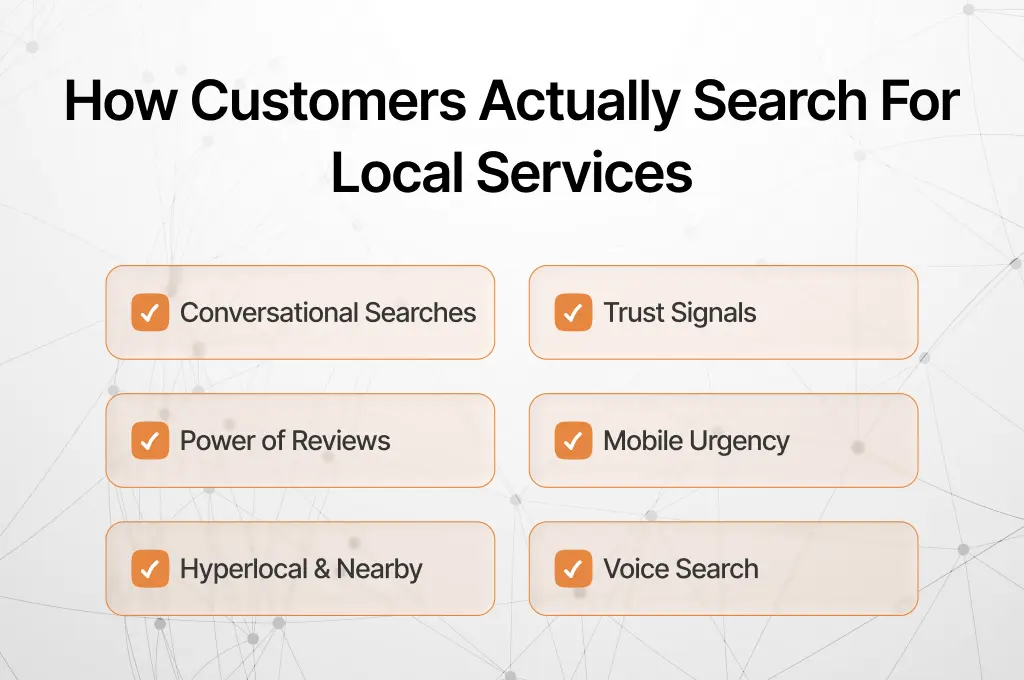
1. Asking Naturally (Conversational Search)
Instead of typing single words, people now use conversational queries like, “suggest me the best plumber near (location) who is open now.” These longer searches help consumers get exact results. Search engines answer in a natural style, which feels more personal and saves time.
2. Checking Reviews and Ratings to Make a Decision
Our experts’ research highlights that local business reviews strongly influence conversions. As many as 95% of consumers read online reviews before making a purchasing decision, a figure that continues to grow (textedly). A positive rating builds confidence, while a low rating often sends people away. For many consumers, reviews matter more than ads or flashy websites.
3. Hyperlocal Content and “Nearby” Product Searches
Consumers want results that match their street, town, or neighborhood. Hyperlocal content from local SEO experts helps them see if a business is truly close. Searches like “shoes nearby” or “coffee near me” guide them to services within walking distance.
4. Trusting Verified Profiles
Trust signals like consistent NAP (name, address, phone), EEAT signals, and a clear online reputation help businesses prove they are real. When these details match everywhere online, it strengthens your local branding and makes consumers feel safe to reach out.
5. Acting Fast on Mobile
Most searches for local services now happen on mobile devices. People search while traveling, shopping, or even standing outside a store. Quick answers on a phone can decide who wins the customer.
6. Using Voice Search for Local Businesses
Voice search makes local discovery even easier. A simple question like “Where is the nearest repair shop?” gives instant results. This hands-free option is popular when people need urgent help.
Why Local Search Behavior Is Changing in 2025
People no longer flip through a directory or ask a neighbor first. Local search behavior has changed because most consumers now turn to the internet to find nearby products and services. In 2025, digital habits and smarter tools guide almost every local discovery.
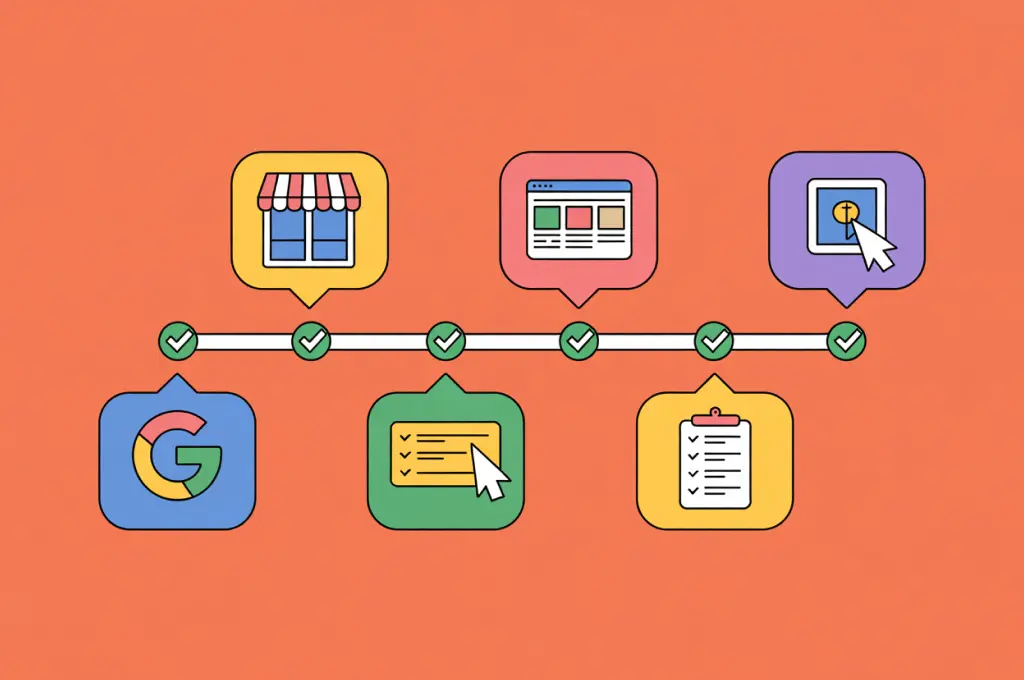
a. Digital-First Habits of Consumers
We have found a recent report from SOCi, which says that 9 in 10 American consumers search for a local business online every week. This stat shows how daily life now starts with Google Search or a mobile device.
People look up a store before they visit, compare prices online, and check reviews to see if the business is trustworthy. If a local shop cannot be seen online, many consumers assume it does not exist or is not trustworthy.
b. AI Overviews and Smarter Discovery
AI has made local discovery even faster. Google now offers AI Overviews that summarize options in seconds. A person might type or speak a conversational query like, “Find me the best coffee shop near me that opens early.” Instead of scanning many sites, they get a quick shortlist with clear details.
This approach pushes local businesses to keep their GBP accurate and updated, or risk being missed in search results.
You can follow our Local Business Marketing Checklist to make sure every part of your online profile is ready for AI-powered search visibility.
c. The Urgency for Local Businesses
These shifts mean local businesses cannot make any mistakes in their digital efforts. Online discovery is no longer optional. Reviews, photos, and consistent business details (NAP) are a must for a local business now.
Falling behind in 2025 means losing visibility when people are actively ready to buy nearby.
Key Statistics That Define Local Search in 2025
Businesses that don’t adapt risk losing visibility right when customers are ready to act. Check out the stats below to see how search habits are evolving and what they mean for local businesses.
- 80% of US consumers search for a local business online every week (SOCi).
- 32% of American consumers look up local business information online at least once per day (SOCi).
- 72% of consumers use Google Search for local discovery, followed by Google Maps at 51% and Facebook at 49% (SOCi).
- Among 18-24 year-olds, 67% use Instagram and 62% use TikTok for local searches, compared to 61% who use Google Search (SOCi).
- 4 out of 5 consumers rely on search engines to gather information about local businesses (Google).
- 76% of consumers who search for “near me” visit a local business within 24 hours (Google).
- 88% of smartphone users who perform a local search visit a related store within one week (Google).
- 46% of all Google searches have local intent, showing how important proximity is to search activity (Search Engine Roundtable).
- 20% of local searches on a smartphone lead to a purchase within one day (Google).
- 42% of people who conduct a local search click on results inside the Google Maps Pack (Backlinko).
- 75% of consumers say they always or regularly read online reviews before choosing a local business (BrightLocal).
- 60% of mobile users contact a business directly through search results without even visiting the website (Google).
- 5.9 million “near me” keywords exist in the U.S., driving 800 million monthly searches (Semrush).
- “Near me” searches peaked at an IOT score of 100 in July 2021, and remain high at 60 in 2024 (Google).
- Google holds a 91% search engine market share worldwide across all devices (Statcounter).
- Google Maps led downloads in 2023 with 21M installs, while Waze followed with 9.89M in the U.S. (Statista).
- Multi-location brands achieved 33.4% Google 3-Pack presence for top keywords in 2023, up from 23.8% in 2022 (SOCi).
- Fully optimized enterprises reached 65.7% 3-Pack visibility vs. 61.6% in 2022 (SOCi).
- Businesses in the Google 3-Pack receive 126% more traffic and 93% more actions than those ranked 4-10 (SOCi).
- Customers are 2.7x more likely to see a business as reputable if its Google Business Profile is complete (Google).
- 70% of customers are more likely to visit and 50% more likely to purchase from a business with a complete profile (Google).
- 44% of local search results contain a featured photo in the listing summary (SOCi).
- The average multi-location brand had 178.8 Google reviews in 2023, down from 223.9 in 2022 (SOCi).
- Google star ratings rose from an average of 3.74 in 2015 to 4.11 in 2023 (SOCi).
- 61% of consumers use business information sites (Google, Yelp, Tripadvisor, BBB) to research a new or unfamiliar local business (Local Business Discovery & Trust Report, 2023).
- 83% of consumers use Google to find local business reviews (Local Consumer Review Survey, 2025).
- 88% of multi-location marketers are using generative AI in their organizations (Brand Beacon Report, 2024).
- 32% of US adults believe AI provides a better experience than traditional search for finding local businesses (Near Media, 2024).
- 94% of high-performing brands have a dedicated local marketing strategy, compared to 60% of average-performing brands (Brand Beacon Report, 2024).
- 56% of business owners handle local SEO themselves, while 25% delegate it to a team member (Semrush).
- 70% of local businesses have conducted a local SEO site audit, but 67% have never done a technical SEO audit (Semrush).
- Businesses in the local map pack average 993 backlinks and 216 referring domains (Semrush).
- 38% of the top 3 local search results include the target keyword in their business name on their Google Business Profile (Semrush).
- 57% of local searches are performed on mobile devices (ReviewTrackers).
- 23% of consumers encounter fake business listings online at least once a month (BrightLocal).
These numbers show a clear trend: local search is becoming more mobile, conversational, and reliant on trustworthy information. Whether through voice assistants, AI overviews, or “near me” searches, your future customers expect instant answers.
Local SEO Mistakes Businesses Still Make in 2025
Many local businesses want more customers, but still repeat mistakes that limit their visibility. Reports on local SEO statistics show these gaps clearly. Knowing these issues helps business owners avoid falling behind.
-
Ignoring AI Overviews & Voice Search Optimization
AI Overviews now guide a large part of Google Search results, and voice search has become common on mobile devices. Yet many businesses fail to adapt their content. Without simple, conversational answers, they miss consumers who rely on quick spoken queries.
-
Inconsistent NAP Citations Across Directories
NAP means name, address, and phone number. If these details appear differently across Google Business Profile, directories, or social pages, trust breaks down. Consumers expect accurate contact details. Search engines also see inconsistency as a weak signal, which lowers the overall visibility.
-
Poor Online Reputation Management (Reviews)
Reviews remain a top decision point for American consumers. BrightLocal data shows how strongly ratings affect trust. Many local businesses ignore local branding and reputation management. A lack of response to negative feedback or no plan for gaining reviews can damage credibility fast.
-
Lack of Hyperlocal Content Strategy
Consumers search for nearby products and services in very specific ways. Without hyperlocal content, businesses cannot connect with these searches. Pages that mention local landmarks, towns, or neighborhoods improve discovery. Ignoring this strategy leaves competitors with a clear advantage.
-
Neglecting Mobile User Experience
Most local searches happen on mobile devices, yet many sites still load slowly or show poor layouts on small screens. A clunky mobile experience frustrates consumers and increases the chance they move to a snappy competitor.
-
Forgetting Consistent EEAT Signals
EEAT stands for expertise, experience, authority, and trust. These signals help search engines confirm if a business is reliable. Lack of clear author details, accurate information, or trust signals lowers visibility in both AI-driven results and regular search.
Recovery & Optimization Strategies
Better local search performance takes clear steps and consistent action. Businesses that act quickly can regain visibility and attract more nearby customers in 2025.
1. Optimize for Voice & Conversational Queries
Many people now use voice search on mobile devices to find services quickly. Phrases like “best plumber near me open now” need clear answers on your website and Google Business Profile. Optimization for these queries helps your business appear in AI-driven overviews and conversational results.
2. Strengthen GBP and Review Management
A strong Google Business Profile is central to local visibility. BrightLocal shows that regular review monitoring, prompt replies, and accurate business information build trust. A response to both positive and negative reviews shows care, builds consumer confidence, and boosts search rank.
3. Create Hyperlocal Content & EEAT-Driven Pages
Pages that focus on neighborhoods, towns, or local landmarks increase relevance for nearby searches. Adding clear EEAT signals- expertise, experience, authority, and trust- helps search engines recognize credibility. Hyperlocal content and proper EEAT elements guide consumers to reliable local options.
4. Measure & Adjust with Local SEO Tools
Tools like BrightLocal, SOCi, or Google Business Profile insights help you track performance. These platforms reveal which searches bring customers, highlight gaps, and suggest adjustments. Regular measurement ensures strategies stay effective and aligned with local consumer search trends in 2025.
5. Continuous Improvement and Monitoring
Local search is always changing. Businesses that revisit content, monitor reviews, and update profiles can maintain trust and visibility. Consistent optimization reassures consumers and ensures your business stays top-of-mind for nearby services.
Tools & Resources to Stay Ahead in 2025
A local business today requires more than guesswork. With so many changes in local search behavior, reliable tools make the process easier. You will require local business review statistics on how people find nearby services. These platforms give insights, save time, and help protect steady growth.
A. BrightLocal
BrightLocal offers strong support for reviews and citation management. It helps businesses collect customer feedback, monitor ratings, and fix inconsistent NAP details across directories. A clean profile improves trust and keeps local SEO signals strong.
B. SOCi
SOCi focuses on local marketing data and management. It shows how consumers interact with your brand across digital touchpoints. From analyzing reviews to tracking campaigns, SOCi gives managers a clear picture of what works and what needs improvement.
C. Statista
Statista delivers detailed consumer trend reports. For business owners, these reports explain how American consumers search for nearby products and services. The data is simple to compare. So, it is very useful for spotting shifts in local consumer search trends in 2025.
D. Google Business Profile Insights
Google Business Profile insights reveal how customers search for local businesses directly on Google. Owners can see which keywords triggered visits, what actions people took, and how often their profile appeared. This data guides better decisions for local visibility.
E. AI-Powered Keyword & Entity Tools
AI-powered tools now uncover hidden keywords, entities, and conversational queries that shape discovery. They highlight what people ask in voice search and AI overviews. It lets businesses plan hyperlocal content and build stronger EEAT signals with less effort.
Final Thoughts: The Future of Local Search
Local search in 2025 has evolved beyond simple Google results. With AI-driven overviews, voice searches, and mobile-first habits shaping customer decisions, local visibility now depends on accuracy, trust, and consistency. Businesses that adapt to these changes will be the ones customers find first.
Growth for Local helps service-based businesses stay visible, trusted, and competitive in this new landscape. Our team specializes in strategies that strengthen your local presence and attract real customers, not just clicks.
If you want your business to lead in how customers search in 2025, partner with Growth for Local and start growing where it matters most.